



How can we ensure a culture of making, rather than just consuming, is preserved in future generations?
This is part two in a two-part interview series with Simon Sarris. In part one, Simon Sarris told us how he and his wife Simi built a hands-on life from scratch — the house, the land, the habits of making. This week we turn to the harder question: how do you pass that life on? A conversation about rituals, chores, knives, and raising children who make things rather than merely consume them. If you’re looking for part one, you can find it here.
—----------
Nicole: Do you feel like Simon now is completely expectable, based on your childhood?
Simon: In one way, yes. In most ways no. I don’t recall anticipating very much when I was young. I have no memory of, “When I grow up, I’m going to be like this.” The only memory I have of future thinking is that sometime in high school I liked making things. I liked making art and poetry, though I was never very good at either. I found programming to be especially alluring because, when you don’t have materials or tools, you can make things on computers and it’s free.
So I chose computer science as my major — I ended up majoring in Computer Science and Philosophy in college — over something like engineering or biology because those have all these extra requirements. If you want to do, say, woodworking, you have to buy all these materials and tools. Engineering needs lots of capital; biology needs a lab. With a computer, you don’t need anything. You don’t need anybody’s permission. You can just make stuff and then people can use it. That felt quite enchanting as a child. I still think programming is a uniquely magical experience. Anyway, with programming, I didn’t have to beg for (say) woodworking tools, which I probably would’ve never asked for anyway, because I was too shy. I’m sure my parents would’ve tried to give me whatever I asked for, but I didn’t ask. The idea that with a computer you can create and no one is going to stop you, or ask you for money or for permits, it felt kind of incredible. I went into it for that reason.
Once I started making money after college, it felt very natural to save up and try hobbies like photography, woodworking, and eventually buying land. From there, getting enough tools to clear land by hand, to build a chicken coop, a garden, and so on. That feels like a natural progression. I could imagine nine-year-old me thinking, “That makes sense. Why wouldn’t you do that?”
Household Rituals
Nicole: And now the seed of all of those practices has grown into a very beautiful flourishing set of disciplines that you pull your children into. How do you think about setting family culture? What sort of rituals does the Sarris family have?
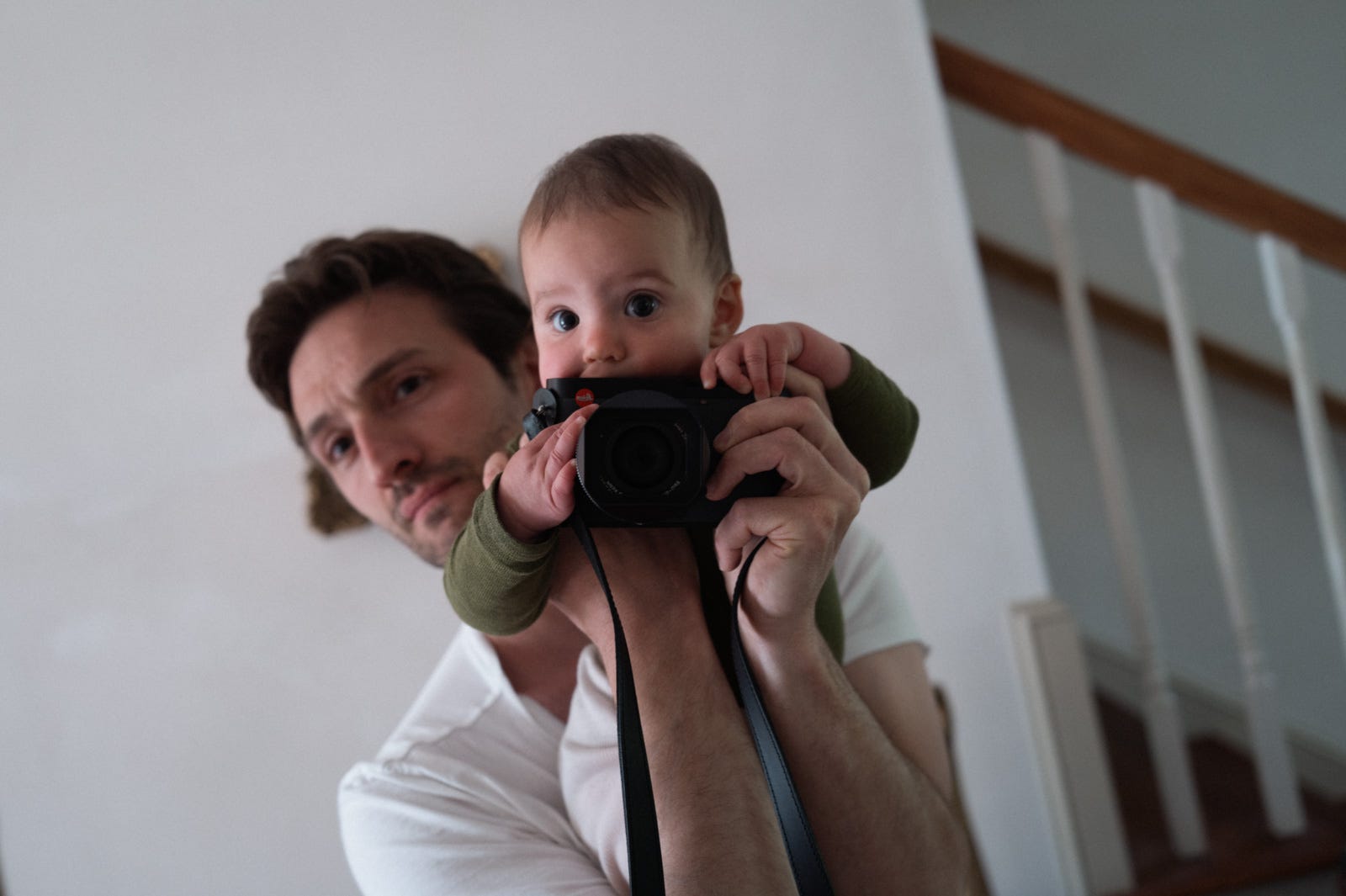
Simon: We heat our house with wood. In the deepest part of winter, it’s me getting up in the dark, starting the wood stove, and making coffee. Simi comes downstairs, and it’s just us. Now with our one-year-old baby. So every morning we sit together quietly for a while. Sometimes we might read, sometimes we might look at something together, but often we just do nothing but drink coffee together.
As things start to heat up, and there’s more sunshine, maybe Simi will get up before me instead and start the fire. Occasionally she makes coffee, but I like the idea of making coffee for her every day. The children stay in their rooms until we’ve had time with each other for a while. Then we go and get the children, and they are supposed to tidy their rooms before they come down. Sometimes they do that quickly — sometimes they take half an hour or more, jumping around and talking to each other upstairs. They come down and (the 5 and 3 year old) unload the dishwasher, then have their own breakfast, and then Simi and I have breakfast together every single day. Then I go to work, which either means I go into another room of the house, or into the office. That’s pretty consistent: almost every single day we get up together, we have coffee together just Simi and I, and then we have breakfast together.
Throughout the day life is dotted with other rituals. Simi and I, almost every single day, also have coffee in the afternoon, between about one and two o’clock. If she’s out on a walk she might text me and say, “Could you make me coffee?” So that by the time she’s home, we’re ready to sit together. In nice weather that’s sitting outside, in the winter it’s by the fireplace. We have dinner together every single night, unless I’m very late at the office — the whole family, always together, seven days a week. This was distracting at first, since babies need a lot of attention while eating, but now with three children it’s easier to teach table manners. The older ones give the younger one an idea of how you’re supposed to act.
Nicole: What ages are your kids?
Simon: They’re five, three, and one.
Nicole: The idea that family dinner culture begins to pass itself along is very encouraging, because we do largely the same. Our freshly-turned three-year-old — he actually turned three yesterday — is pretty well-behaved, but it is still more of an ordeal.
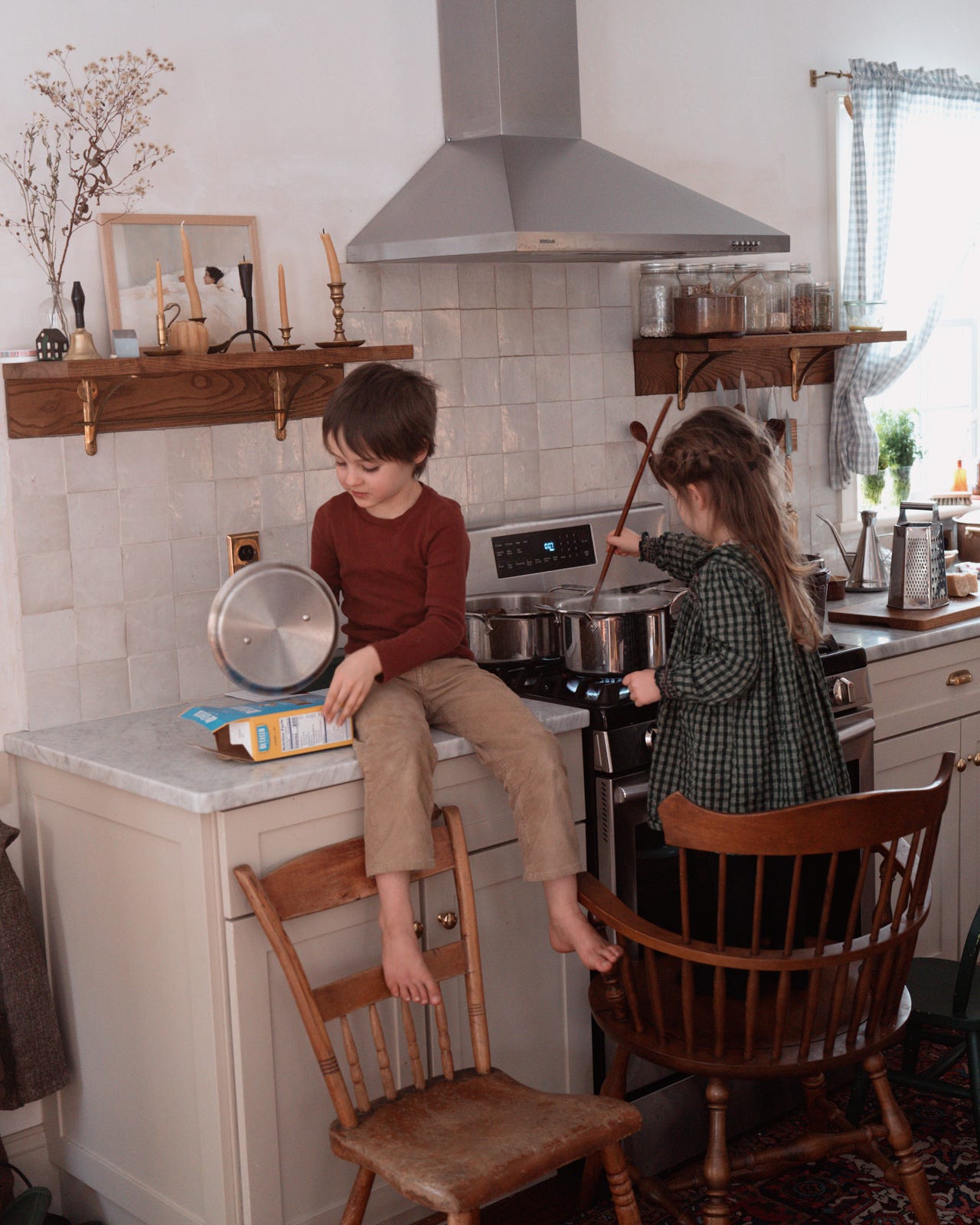
Simon: It gets much better when they’re older. Lu at three was difficult, but at five he’s a steward of his little sister. It just gets better and better. Once you have two children around ages five and three, and one can lead the other around and talk to them and invent games together, it’s really great.
Nicole: You said the kids have a different breakfast. Do you prepare that first?
Simon: Simi usually prepares their breakfasts and then ours, or we prepare ours together. Sometimes I’ll prepare their breakfasts if Simi is busy, for example working out. The very first step is the five and three year olds take all the dishes out of the dishwasher, so they actually have the first work of the day. Then we can get to their breakfast.
Before we had children, we were both in the kitchen a lot. We both love cooking. During Simi’s first pregnancy, where she almost needed to eat something different every day because of aversions, we would spend hours cooking together. Now that we’re much more busy, it’s more of a division of labor. She does most of the cooking. If I work at home, it’s very easy for me to be at work, and then come out, make pasta dough during the day, and then come out again at four o’clock to roll and cut the pasta. So I can still help with cooking, and it’s very easy to punctuate your day with mostly unattended cooking work if you work at home.
Nicole: A lot of people talk about the benefits of remote work, but they rarely talk about the fact that if you’re back in the house, it’s easier to do all the things you need to do with bread.
Simon: Definitely. We make all our own bread. It’s so easy since it’s mostly unattended. If you’re around all day, you don’t even give it a second thought.
Nicole: One of my dear friends is writing her PhD on the change of marketing and technology in household work over the last two decades. We talk a lot about norms that people forget were so different so recently. Cooking can feel like it has an intense overhead, because the norm is that people are not around their house in the same way as perhaps one hundred years ago, where you were in or around the house much more often, or there was someone who could do the small tasks over the course of several hours.
Simon: If you can plan ahead and you have a bit of schedule-keeping, then it’s easy to plan: you need to soak beans, you need to take the sourdough out of the fridge, maybe you need to take meat out of the freezer the night before. Once you have the tempo and the intuition for it, it becomes much easier. But if you’re only ever cooking sporadically, it’s much harder to get such a tempo.
Involving Young Children in Cooking
Nicole: How do you bring the kids into these rituals and into meals?
Simon: I think “work” is an underappreciated word. All the children have their work, and they know that you work to have good things. Before they eat their breakfast, the children take everything out of the dishwasher. They know they have to do this because they have to get the bowls in order to have something to make breakfast in. Lu likes being in charge — if you give children a little bit of authority, they take things much more seriously. He has to make sure the one year old isn’t handling any of the fragile bowls that could easily break, and so he’s sure to hand her the more durable things to put on the counter.
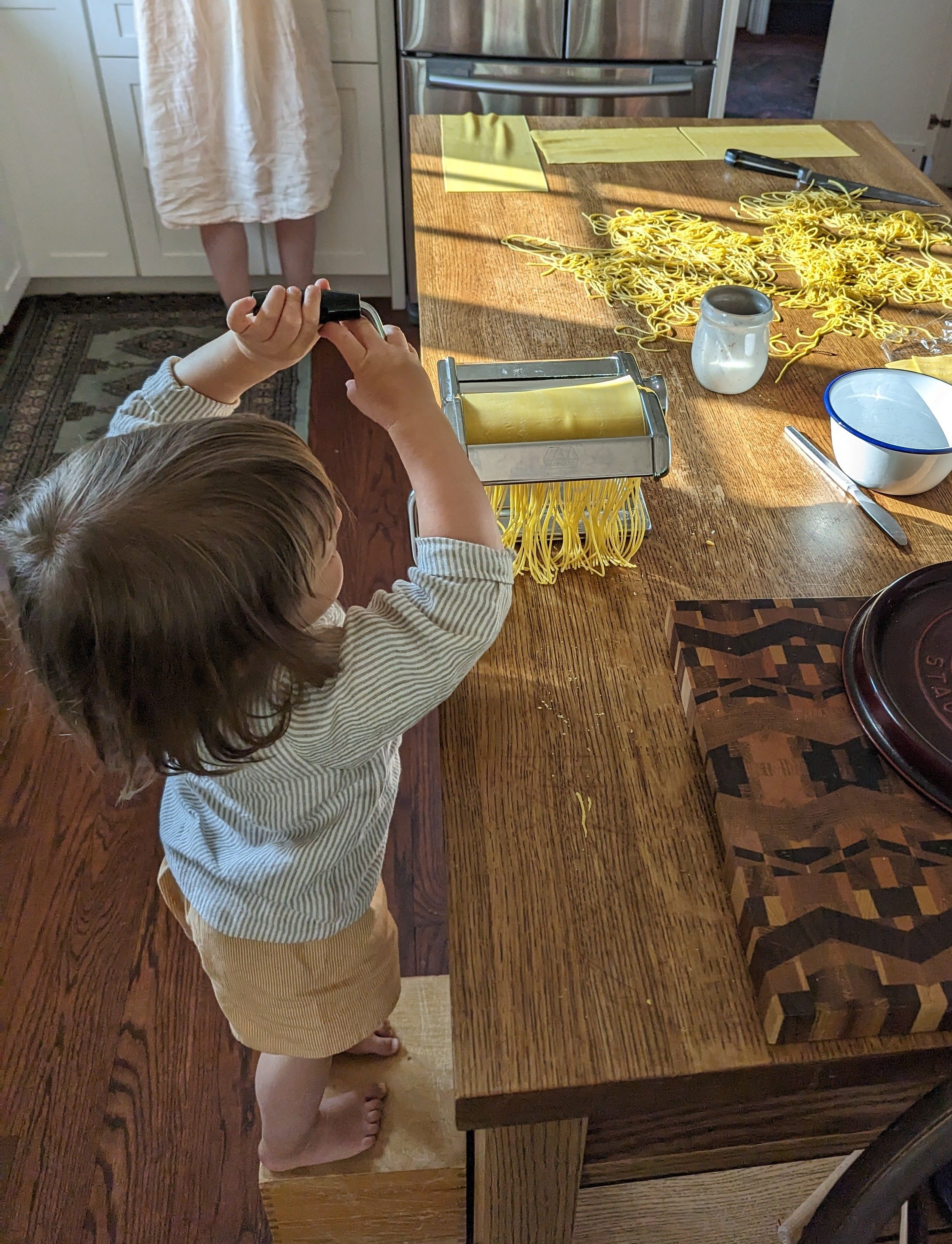
They help with everything, but especially with tidying, laundry, cooking, and so on. We try to include them in everything, even if it takes longer. Even if I’m trying to get the pasta done quickly and I can’t want to wait for Lu to help roll it out, I might give him his own piece of dough and a rolling pin and just have him practice. It’s more parallel play than direct involvement, but it’s just as important for him. He’s still engaging with and making dinner.
When cooking Simi always has tasks for them along the way: she makes sure they’re the ones pouring the olive oil and doing the salting. If we’re doing roasted potatoes or a carrot salad — where it doesn’t need to be perfectly accurate — she just gives them a knife. If our three year old has a knife, it’s fine. They’ve had so much supervision at an early age, now that Lu is five it’s very easy to leave him unattended and say, “Cut up these carrots and cucumbers and put it into a bowl, and add a little vinaigrette.” He can guide the three year old and make sure she’s doing things correctly, because he’s been so engaged.
Nicole: How well does that work?
Simon: He can’t necessarily give her proper technique, but he can alert us about improper technique or if she’s being dangerous.
We have a chair pulled right up to the kitchen island at all times, so a child can stand and do work. It’s very easy to just pass them a cutting board. If there’s two of them, Lu can grab another chair and bring it right up to the island.
Nicole: How do you deal with cleaning and other household work?
Simon: In terms of housework like cleaning, we don’t hire for anything. That makes it more imperative that the children are learning to help. Nothing gets cleaned unless we do it. The children need to know that. If Simi is cleaning, they’ll clean with Simi. Before dinner we’ll have “tidying” – they have to make sure everything in the living room is clean. If they’re playing with couch cushions, they have to be back on the couch. All the train tracks have to be in the train box, and so on. Establishing these precedents make it a lot easier.
Sometimes online, people say things like, “What you don’t see in Simon’s pictures is an army of nannies and cleaners.” And while I think that kind of help is good if you can find it, we don’t have anything like that. The rug in our kitchen is a dark patterned rug that’s not as clean as it might be if we had people come and scrub things spotless. Simi and I are both pretty clean people, maybe an eight out of ten, but things are not as clean as they might be.
In terms of other work, my mom comes over at least once a week to play with the children, which is nice because it gives Simi a bigger block of time each week. If I’m at the office, she can just go out and do errands or get away from children jumping around for a while. My mom is in some ways the biggest second caretaker, and she really likes that.
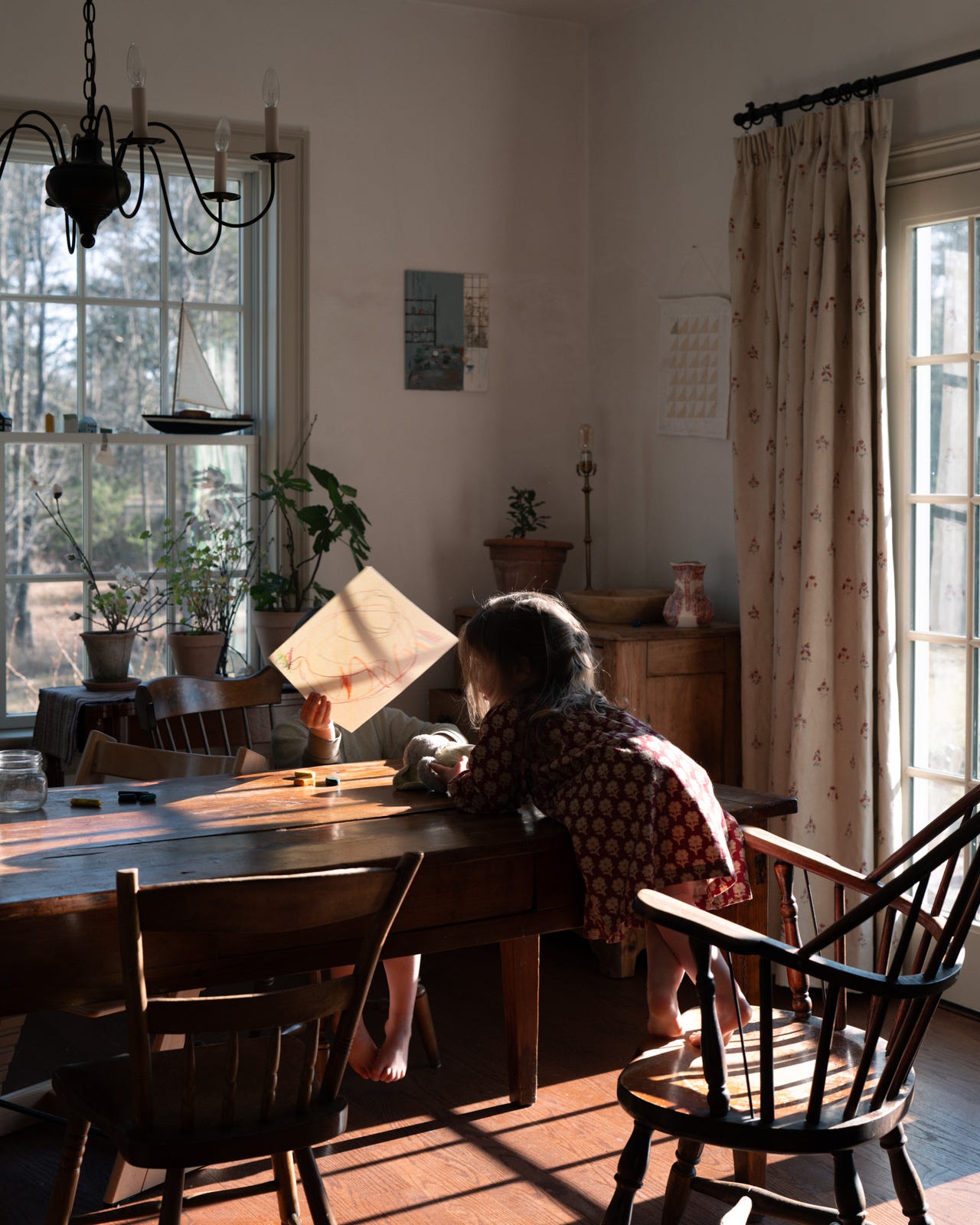
Now that they’re five and three, it’s very easy to have them be self-directed for hours at a time without any input from us. A lot of that is drawing, painting, and audio books, which they’re crazy about. And maybe most important for us getting things done is that we have a kind of “Quiet Hour” instituted while the baby is napping. The children either have to play in their respective rooms by themselves, or Lu might listen to an audiobook, and during this time they are learning to do their own thing and also giving us time to do things we need to get to.
Nicole: Do you use the Yoto player for audio books?
Simon: We don’t. We’re pretty resistant to adding new devices to the house unless they’re really compelling. For audiobooks we decided to just try giving Lu a bluetooth speaker, and we set up Audible or Librivox for him, and this has worked so well that we don’t feel like we need another device. So he’ll ask to listen to Winnie the Pooh or one of the Thornton Burgess animal stories, or any number of other books we put it on, and he goes off to a quiet spot to listen for an hour.
Nicole: I was surprised by how much our 3yo son loves audio books, and how much he internalizes them at a young age.
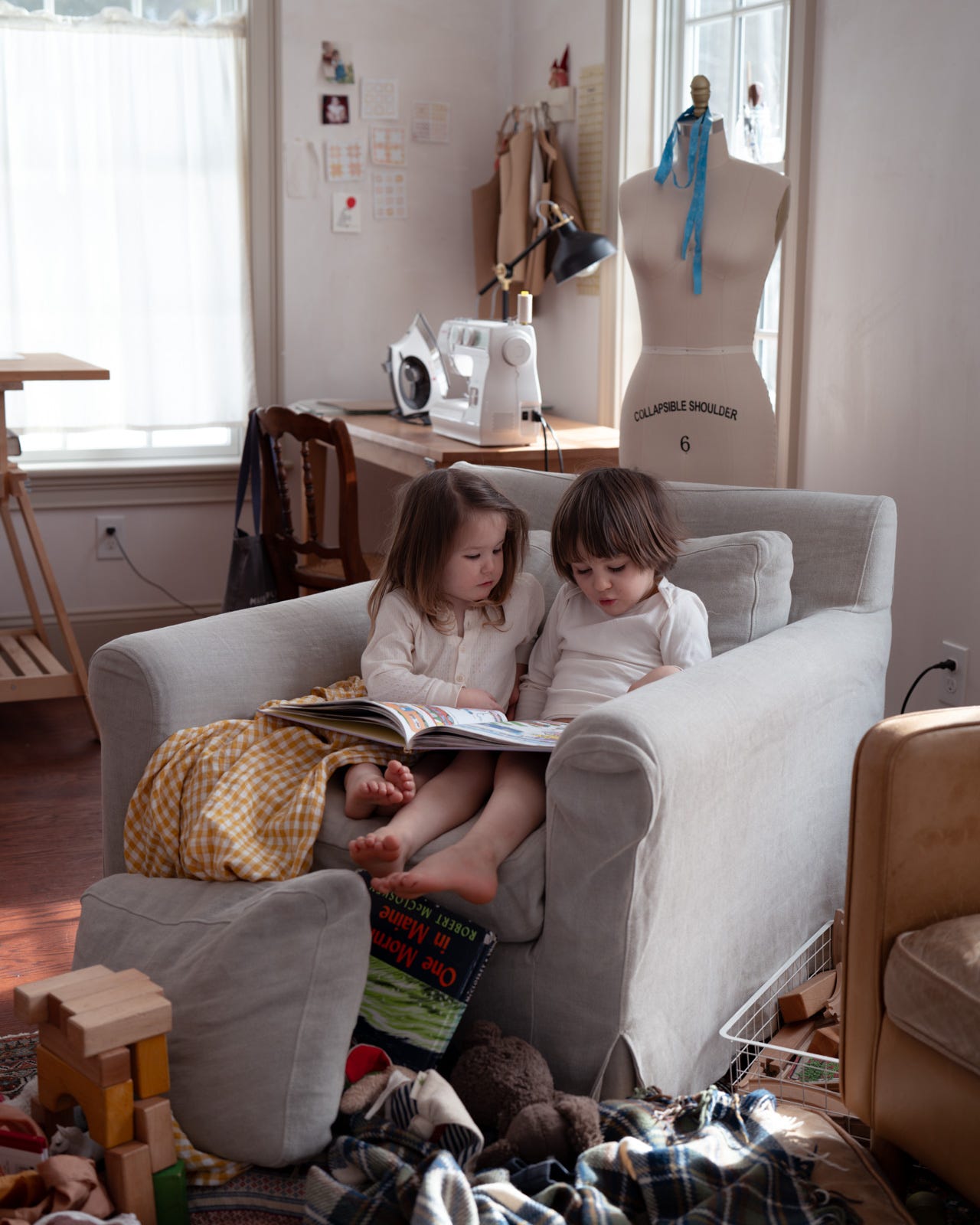
Simon: They remember a lot, especially if you repeat them. One other ritual is that Simi reads to the children at least three times a day. When I start work, they have their morning book where one of them chooses a book and she reads to all three of them. Then at tea time — after their nap, between two and three — they all get up, have a snack, and Simi reads to them again. Before bedtime she reads to them a third time. Sometimes the reading is small and other times it’s quite long. Because of that, they’re all very primed to listen, and audio books seem like a natural extension of that.
Embracing Viscerality
Nicole: I’m very interested in the broader cultural reaction to technology right now, especially to LLMs, and this idea that friction is not always bad. How do you handle that with your kids in an era where it’s obviously very easy to eliminate friction across life?
Simon: I love technology, but I just think we use 99% of it badly. Our default is not exactly to say “no” to technological solutions to things, but to see if a low-tech way accomplishes the same thing. Often there may be less complex, or more robust, or more pleasant or beautiful ways to do something. Simi and I do a lot of things by hand — she sews her own dresses, shirts, and skirts, and I do a lot of woodworking to make implements that I could probably buy on Amazon for less, and certainly in less time. We have this religious appreciation for doing things by hand in a way that’s hard to justify rationally, and we’re perfectly happy with that. I like sweat. I like art that shows its thumbprint and effort.
And I like the extra “friction” because you might encounter rewarding experiences. For example going to the library to get books instead of ordering everything off Amazon, you end up meeting the librarians and talking to them, and this is highly worthwhile for the children. We have a library that we can walk to every day. All the librarians know our children’s names and love them. They go there and feel like they are part of the world because all the librarians say, “Hi, Lu!” and so on. You can’t replicate that by ordering off Amazon, even if the book is $3 used. Kasey Klimes wrote about friction very well — the idea that you might want to introduce more of it.
Nicole: Your essay on viscerality is tackling this from a different angle.
Simon: Yes. The more you simplify certain things, the more you risk leaving out what’s good about them. Reading a summary of a novel is useless compared to reading the novel — you don’t get the emotive feeling at all, you don’t get the moods that stay with you long after you’ve forgotten the details of the story. A novel isn’t just a plot but a set of interactions that course through you while it’s happening.
People have a lot of wants, and they tend to want “more, faster” more than they want things to ultimately feel good in their lives. In writing Viscerality I was trying to convey the important parts of pleasure that seem, to me, too much looked-over these days.
Nicole: How would you recommend parents take a small step to begin raising makers?
A lot of people want their children to become readers, but they are not big readers themselves. This presents a problem. Your children are with you every day and they see what you are doing, and they ingest whatever that is as a set of norms. So if you want them to be interested in reading you’re going to have to be interested in reading yourself. I think it’s this way with everything. If you want them to make things, it has to be a normal part of your life to make things. Lu thinks that people just decide to build barns and sheds, so he goes around on the land and makes “caves” and “store houses” in his own way.
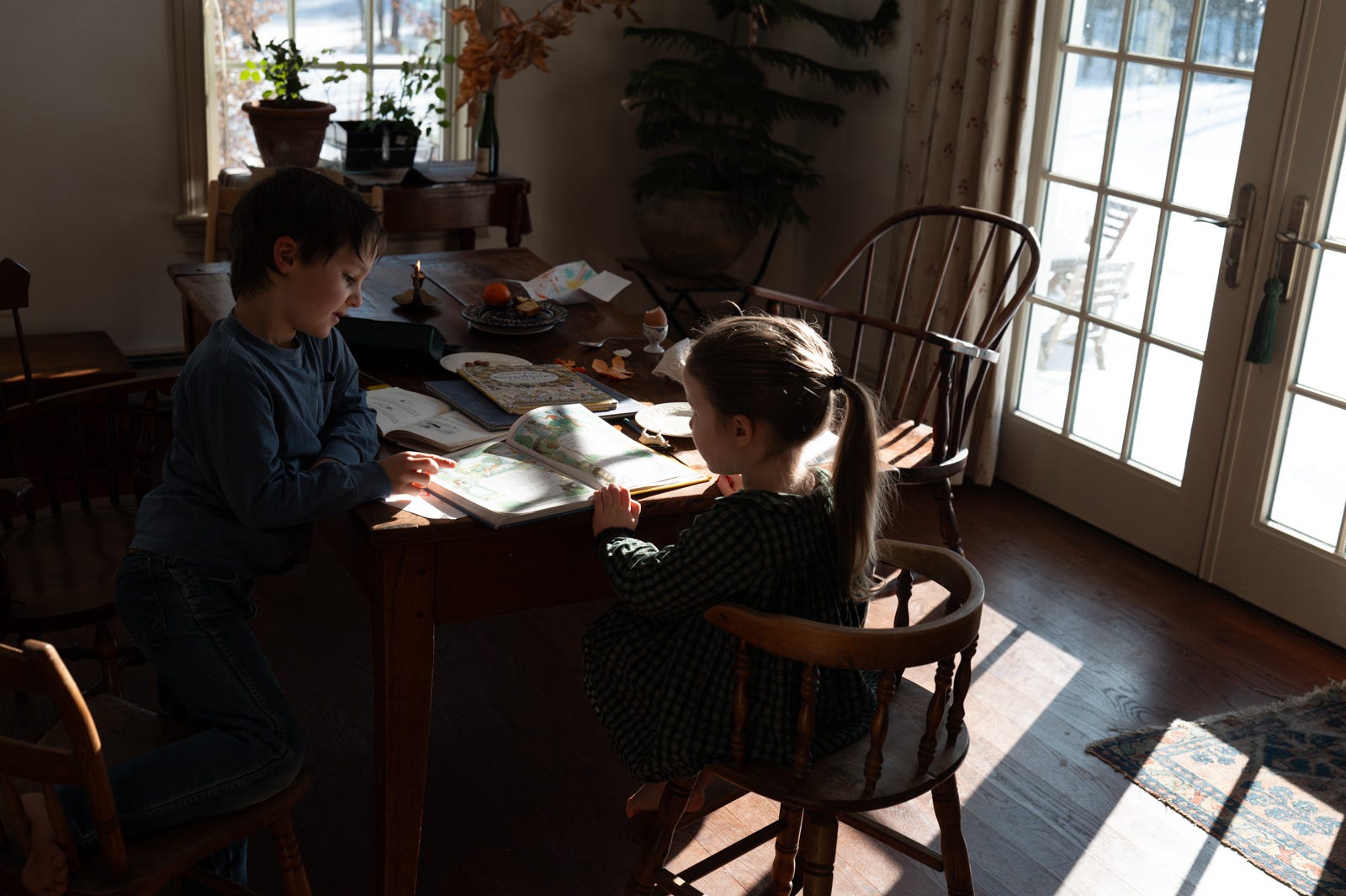
So you have to think not just what you want them to be doing, but what behaviors you do that they can emulate, even if only in a smaller way. Of course this may give you some opportunities when they’re a little bigger. If you always wanted to take a pottery class, maybe you can take one with your twelve year old. They might get around to stuff like that in normal school, but it will be more rushed and sparse. You can do it intensively, and you can do it with them. I mentioned permission earlier. As a child I didn’t know what I was allowed to do, exactly, mostly because I didn’t even know what all the options were. I want to make sure my children know what you can make, how you can interact with the world. They’ll always have tools and materials at hand, projects for them to start on their own, and projects they can join us on. To me these are some of the most important parts of education.

This interview series is made possible by the Foundation for American Innovation and the Institute for Family Studies.
Thank you to Harry Fletcher Wood for his edits.
I keep Twitter push notifications turned off on my phone and am not much of a poaster, but I keep post notifications turned on for 4-5 people whose posts consistently delight and inspire me, two of whom are Nicole and Simon. I've taken countless cooking, childrearing, lifestyle, and design ideas from you both over the last several years. So happy these interviews are out in the world!
Excellent interview!